





Traveling the world sounds great—until you realize your bank card is blocked, exchange rates are terrible, and your “international” payment method suddenly isn’t so international.
Now imagine this instead:
You land in a new country, connect to mobile data instantly, order a ride, book your hotel, and grab dinner—all without touching fiat.
Welcome to traveling on crypto.
In 2026, it’s no longer a niche experiment. With the right setup, you can realistically live off crypto while traveling. But it’s not as simple as “Bitcoin fixes this.” You need the right tools, a bit of planning, and a backup strategy or two.
Let’s break it down.
Can You Really Travel Using Only Crypto?
Short answer: yes—with some workarounds.
Long answer:
Crypto still isn’t universally accepted, especially in physical locations. While some countries and cities are more crypto-friendly than others, most travelers rely on a mix of:
- Direct crypto payments (rare)
- Crypto debit cards (convenient but limited)
- Indirect methods (most reliable)
That last category is where things get interesting.
Because today, you can effectively use crypto for everyday travel needs—even if the merchant doesn’t accept it.
The Reality: Crypto Travel Is About Workarounds
Think of traveling with crypto less like a straight line and more like a toolkit.
You’re not replacing money—you’re replacing how you access it.
And yes, this is where we introduce the classic:
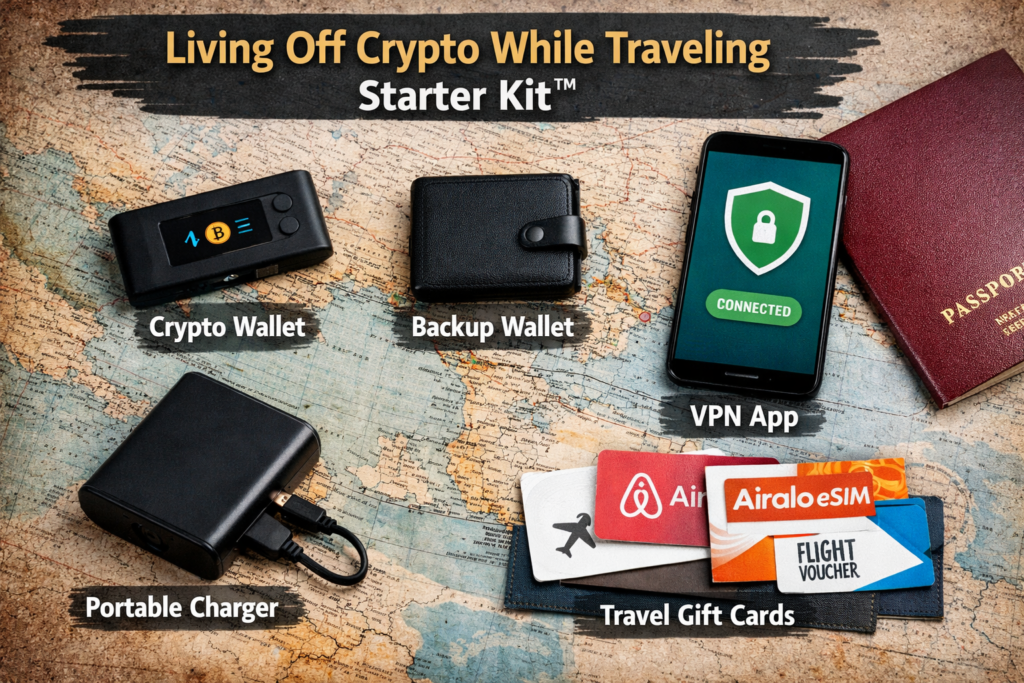
If this were one of those 2016 old-school images, it would include:
- A crypto wallet (obviously)
- Backup wallet (because paranoia is healthy)
- VPN (you’ll thank yourself later)
- Portable charger (critical infrastructure)
- And… a way to actually spend your crypto in the real world
Let’s go through what that actually means.
5 Practical Ways to Live Off Crypto While Travelin
1. Gift Cards: Your Global Payment Hack
This is the single most flexible method available today.
Instead of hoping a hotel or airline accepts crypto, you convert your crypto into something they do accept—gift cards.
That allows you to:
- Book hotels
- Order food
- Use ride-sharing apps
- Shop online
- Pay for entertainment
In practice, this means you can use crypto for everyday travel expenses almost anywhere in the world.
For example, you can:
- Book accommodation via platforms like Airbnb
- Pay for Uber rides
- Order food delivery
- Shop on Amazon while abroad
All by using services that let you spend crypto on travel and everyday services.
2. eSIM Cards (Your Internet Lifeline)
If you’ve ever landed in a new country without internet, you know the pain.
No maps.
No Uber.
No translation.
No idea where you are.
That’s where eSIM providers like Airalo come in.
With crypto, you can easily purchase mobile data plans and stay connected instantly. No physical SIM cards, no local stores, no confusion.
This is one of the most underrated ways to stay connected while traveling with crypto—and arguably the most important.
Because without internet, none of the other methods work.
3. Crypto Debit Cards
Crypto debit cards still play an important role.
They allow you to:
- Pay in restaurants
- Withdraw cash
- Use standard card terminals
But they come with trade-offs:
- KYC requirements
- Fees
- Potential card freezes
- Dependence on centralized providers
They’re useful—but not something you should rely on exclusively.
4. Booking Travel Services with Crypto
Flights and hotels are still one of the biggest friction points.
Some platforms accept crypto directly, but coverage is limited.
Instead, many travelers use indirect methods to:
- Book flights
- Reserve hotels
- Pay for travel platforms
This works especially well when combined with the ability to turn crypto into usable travel payments instantly.
5. Peer-to-Peer and Local Solutions
In some regions, especially in Asia, Africa, or Latin America, crypto adoption is more grassroots.
You may find:
- Local vendors accepting crypto
- Informal exchanges
- Peer-to-peer deals
While this can be powerful, it’s not always predictable—so it’s best treated as a bonus, not a core strategy.
The Smart Way to Structure Your Crypto Travel Setup
If you want to travel smoothly, think in layers:
Layer 1: Primary Spending Method
- Gift cards / indirect payments
Layer 2: Backup Method
- Crypto debit card
Layer 3: Emergency Layer
- Small amount of fiat or stablecoins
This setup gives you flexibility without relying on a single system.
Real-Life Example: A Day Traveling on Crypto
Let’s say you’re in Lisbon.
Morning:
- You buy breakfast using a prepaid balance funded with crypto
Midday:
- You order an Uber using a service paid via crypto
- You top up your mobile data plan instantly
Afternoon:
- You shop online or book your next destination
Evening:
- You order food or pay for entertainment
At no point do you need a bank transfer or currency exchange.
That’s what “living off crypto” actually looks like in 2026—not perfect, but very real.
Is It Safe to Travel Using Crypto?
Generally yes—but you need to be mindful.
Key tips:
- Use hardware or secure wallets
- Avoid public Wi-Fi without protection
- Always double-check payment addresses
- Use trusted services only
- Keep backups of your access
Traveling with crypto gives you freedom—but also responsibility.
FAQs About Traveling with Crypto
Can I travel without a bank account using crypto?
Yes, but it requires planning. Most travelers still use hybrid setups.
What is the easiest way to use crypto while traveling?
Indirect spending methods (like gift cards and digital services) are currently the most reliable.
Can I pay for hotels and flights with crypto?
Sometimes directly, but more often indirectly through alternative payment methods.
Do I need internet to use crypto while traveling?
Yes—reliable internet access is essential for managing wallets and making payments.
Is crypto travel cheaper?
It can be, especially when avoiding exchange fees and banking charges—but it depends on the setup.
Conclusion – Crypto Travel Is No Longer a Fantasy
Living off crypto while traveling used to be a niche idea reserved for early adopters and hardcore Bitcoin enthusiasts.
In 2026, it’s becoming a realistic option.
You don’t need every merchant to accept crypto—you just need the right bridge between your digital assets and the real world.
And once you have that, the experience becomes surprisingly smooth.
Or at least smooth enough that your biggest problem is choosing where to go next—not how to pay for it.
![A dark kitchen sideboard with bread, eggs, fruit in bowls, a tablet showing a rising chart, and a small piggy bank on a hex-tiled backdrop.”] ,](https://blog.coinsbee.com/wp-content/uploads/2026/07/image-3-2-150x150.png)